
Bankruptcy Auto Financing in Merrillville: Your Questions Answered

Rebuilding after a bankruptcy filing is hard enough without losing access to reliable transportation. If you need a vehicle during or after bankruptcy proceedings, the questions below cover the essentials. You’ll learn what lenders actually look for, how your current vehicle is handled, and how a new auto loan can help rebuild your credit. Our finance team at Shaver Preferred Motors works with buyers across Merrillville, Gary, Crown Point, Valparaiso, and the rest of Northwest Indiana.
Get Pre-Qualified | Browse Used Inventory | Contact Us
What do you need to qualify for an auto loan after bankruptcy?
Getting approved after a bankruptcy is possible. Lenders who work in this space look for signs of stability rather than a specific credit score. The main factor is a steady, verifiable source of income.
Minimum income requirements vary by lender. There is no single universal threshold. So the practical move is to get an application in front of lenders rather than guess whether you clear a bar.
Here is what you will typically be asked to bring.
|
Document |
What it verifies |
Applies to |
|---|---|---|
|
Computer-generated pay stubs |
Income |
W-2 employees |
|
Recent utility bill or bank statement |
Physical residency |
All applicants |
|
Valid driver’s license |
Identity |
All applicants |
|
Federal tax returns |
Net business income |
Self-employed |
|
Business bank statements |
Cash flow and deposit consistency |
Self-employed |
Having these ready before you visit speeds up underwriting considerably.
Our team works with a network of subprime lenders who understand these situations. The most common question we hear after a discharge is whether a perfect credit score is required. It isn’t. Stability matters far more than the three-digit number. For a fuller picture of how this kind of underwriting works, our bad credit auto loan approval process guide walks through it step by step.
What happens to your current car during Chapter 7 bankruptcy?
Chapter 7 gives you three paths for a financed vehicle.
|
Your option |
What happens to the vehicle |
What happens to the debt |
|---|---|---|
|
Surrender |
Returned to the lender |
Remaining balance discharged; you walk away owing nothing |
|
Redeem |
You keep it |
Lien settled with one lump-sum payment at the vehicle’s current replacement value; the rest discharged |
|
Reaffirm |
You keep it |
Loan stays outside your discharge; you remain personally liable on the original terms |
Redemption is governed by 11 U.S.C. § 722. It is based on what the vehicle is worth today, not what you still owe. It requires a motion filed with the bankruptcy court and a single lump-sum payment. That is why most filers who go this route use a redemption lender to fund it.
Reaffirmation is the most common path for people who want to keep their vehicle. It is a new agreement that keeps the loan outside your discharge. You must stay current on payments to avoid repossession.
If surrendering is the better financial reset for your household, you’ll eventually need a replacement. Our team can walk you through pre-owned options that fit a post-bankruptcy budget without overextending finances you’ve just cleared.
This information is provided for general educational purposes only and does not constitute legal, financial, or tax advice. Bankruptcy procedures, lender requirements, and credit outcomes vary by individual circumstance and jurisdiction. Consult a licensed bankruptcy attorney or qualified financial professional regarding your specific situation.
What is a Motion to Incur Debt for a car purchase?
During an active Chapter 13, you can’t take on new debt without written permission. That permission comes from your Chapter 13 trustee or from the bankruptcy court. Which one applies depends on your district.
In many districts your attorney submits a written request directly to the standing trustee. Trustee approval alone is then enough, and no court order is needed. If the trustee denies the request, your attorney can file a formal Motion to Incur Debt with the judge.
Either way, the review centers on the same question. Is the new monthly payment reasonable, and will it prevent you from completing your existing repayment plan?
In most cases you’ll select a vehicle and obtain a buyer’s order first. That document must show the exact purchase price, the down payment, the proposed interest rate, the loan term, and the monthly payment. Some districts run the opposite sequence. The trustee issues a letter capping your payment, and you shop within it. Your attorney will know which applies to your case.
Trade equity can meaningfully lower the amount you need permission to borrow. Indiana also deducts your trade-in allowance from the taxable selling price. Sales tax is calculated on the difference rather than the full price, and the state places no cap on that credit. The trade does need to be owned and titled in your name. You can value your trade online for a realistic starting estimate. A larger down payment or trade equity also improves your odds, since it reduces risk for both the lender and the trustee.
This information is provided for general educational purposes only and does not constitute legal, financial, or tax advice. Bankruptcy procedures, lender requirements, and credit outcomes vary by individual circumstance and jurisdiction. Consult a licensed bankruptcy attorney or qualified financial professional regarding your specific situation.
Can a past repossession in your bankruptcy stop you from getting a new loan?
A prior repossession is a real hurdle. But having the deficiency balance discharged in your bankruptcy works in your favor. Once discharged, you are no longer personally liable for that balance. It cannot produce a lawsuit or wage garnishment down the road.
Timing matters to underwriters. A repossession that happened after your discharge is generally viewed as higher risk than one resolved inside the bankruptcy. A post-discharge default is a fresh derogatory with no protection behind it.
We regularly work with buyers carrying both a repossession and a bankruptcy. The key is showing stable current income and bringing a meaningful down payment. Lenders set their own minimums, commonly at least 10% of the selling price. A larger down payment generally unlocks better terms.
How do post-bankruptcy interest rates compare to standard subprime rates?
Borrowers often expect post-bankruptcy rates to be far worse than ordinary bad-credit rates. In practice they track the same credit-tier pricing everyone else gets. Your rate follows your credit profile, your down payment, and how much time has passed since discharge. The bankruptcy label by itself is not the driver.
|
Credit tier |
VantageScore range |
Average used-vehicle APR, Q1 2026 |
|---|---|---|
|
Super prime |
781+ |
6.30% |
|
All borrowers (average) |
— |
11.43% |
|
Deep subprime |
300–500 |
21.77% |
Source: Experian, State of the Automotive Finance Market, Q1 2026.
Because rates climb as scores fall, lenders protect themselves by restricting which vehicles they will finance. Most bankruptcy-focused programs cap vehicle age and mileage. Those caps vary by lender, and several are stricter than buyers expect. Confirm the limits before you settle on a specific vehicle.
Our finance team works with our lending partners to match vehicles on our lot to programs that will actually fund. That way you aren’t restarting the search after an approval comes back. If you’re still setting a payment you can live with, our budgeting guide for Merrillville drivers is a useful next step.
What counts as acceptable proof of income if you’re self-employed?
Documenting earnings when you work for yourself takes more paperwork than a W-2 pay stub. Underwriters typically ask for at least your last two years of federal tax returns to verify net business income. One detail catches people out. Lenders use net profit after deductions on your Schedule C, so aggressive write-offs can reduce the income you qualify on.
Many lenders also request business bank statements, commonly six months or more. These track your actual cash flow and confirm that deposits match your declared income. Requirements vary here. Some lenders weigh tax returns considerably more heavily than statements.
Keeping personal and business finances strictly separated helps. Deposit business revenue into a dedicated account and pay yourself a consistent draw. That makes underwriting smoother. Our finance team is experienced at packaging self-employed files for our lending partners.
How long does it take to see credit improvement after a car loan?
When you first take out a new auto loan, your score may dip slightly. A single hard inquiry typically costs five to ten points, and adding a new account contributes as well. This is normal and short-lived.
From there, many borrowers begin seeing steady improvement within 6 to 12 months of consistent, on-time payments. Timelines vary, though, depending on your starting point and what else appears on your report. A full year of on-time payments builds a fresh positive trade line. That carries real weight against the bankruptcy filing.
For any of this to register, your lender has to report your payment history to the major credit bureaus. Consistent on-time payments are one of the most effective ways to work out of subprime interest brackets over time.
If you’re ready to take that step, our finance team at Shaver Preferred Motors can walk you through the details. Visit our showroom at 5701 Broadway in Merrillville, or call 219-235-8687. Newer to auto financing generally? Our first-time buyer’s guide to financing a used car in Northwest Indiana covers the fundamentals.
Get Pre-Qualified | Browse Used Inventory
Disclaimers
This information is provided for general educational purposes only and does not constitute legal, financial, or tax advice. Bankruptcy procedures, lender requirements, and credit outcomes vary by individual circumstance and jurisdiction. Consult a licensed bankruptcy attorney or qualified financial professional regarding your specific situation. Loan approval, rates, and terms are determined by third-party lenders and are subject to credit approval.
Interest rate figures cited are national averages published by Experian in its State of the Automotive Finance Market report for Q1 2026 and are shown for comparison purposes only. Your actual rate will vary based on credit profile, down payment, loan term, vehicle, and lender. Vehicle age and mileage eligibility requirements are set by individual lenders and are subject to change.
Indiana sales tax treatment of trade-in allowances is described in general terms and reflects Indiana Department of Revenue guidance current as of August 2026. Tax treatment depends on the specifics of your transaction and is subject to change. Consult a qualified tax professional regarding your individual situation.

Financiamiento de Autos con Mal Crédito en Merrillville, Indiana
Ver Inventario Contáctenos ¿Qué puntaje de crédito se considera “mal crédito” para financiar un auto? Una puntuación FICO inferior a…
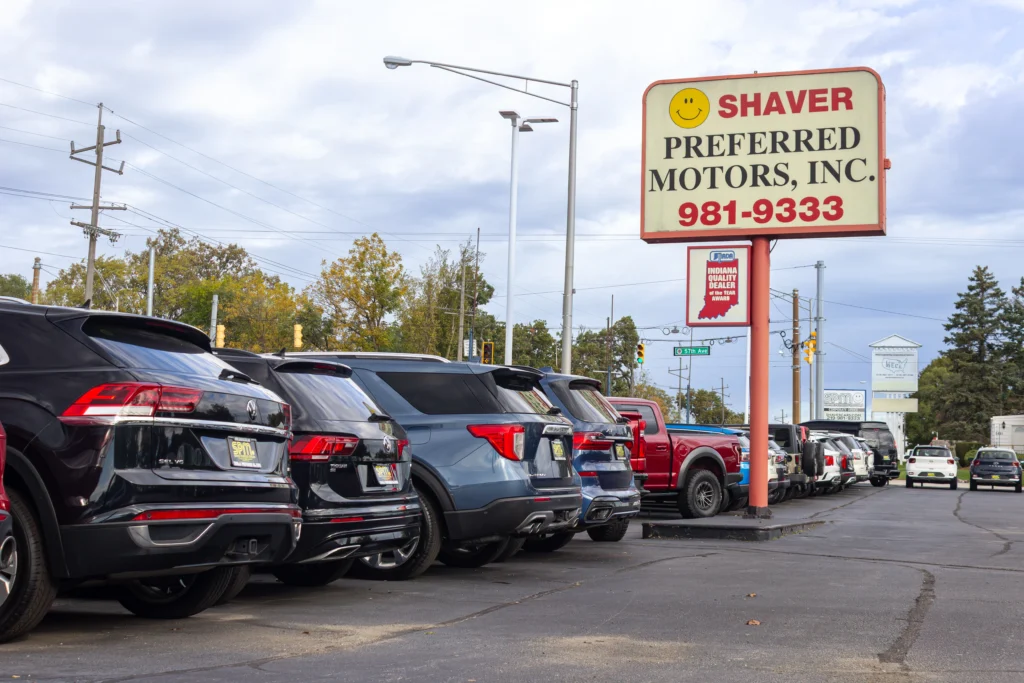
Cómo comprar un auto después de una bancarrota en Indiana sin cometer errores comunes
ContáctenosVer Inventario de Vehículos Usados Volver a tener transporte propio después de una quiebra es completamente posible. Lo que cambia…
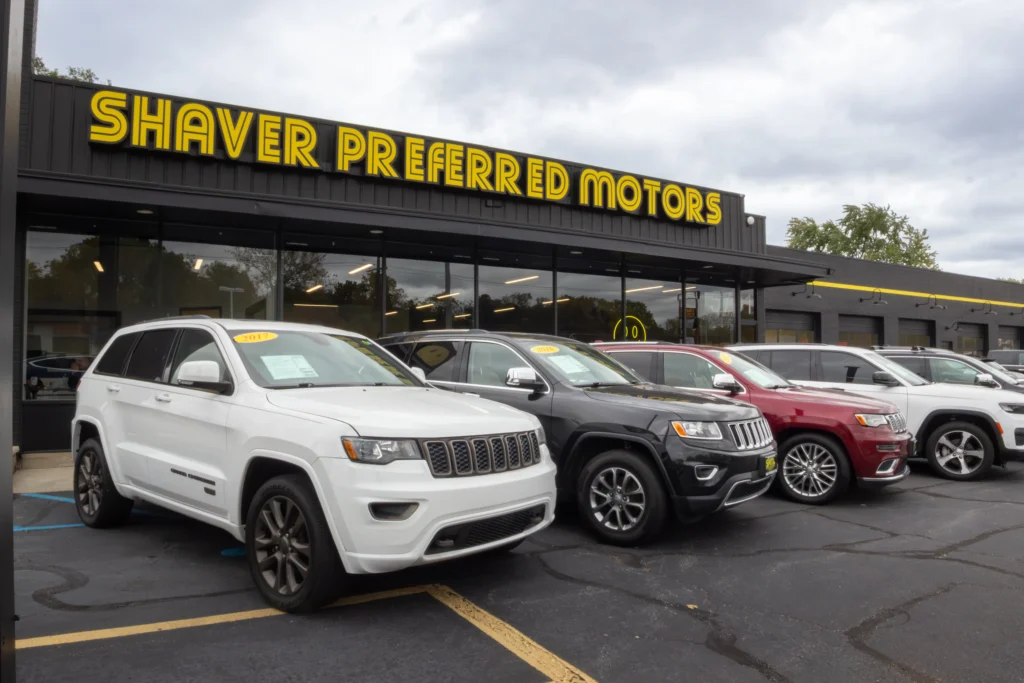
How to Get a Car Loan After Bankruptcy in Indiana
Contact UsBrowse Used Inventory Rebuilding financial stability after a major setback takes clear, practical steps — and for most Northwest…